Walter Saukin, Ph.D., Impacting Generations of Engineers
Forty-Eight Years
That’s how long Walter Saukin, Ph.D., associate professor of civil and environmental engineering, has been teaching at Manhattan University. During that time, he’s become a distinguished member of the engineering field, instructing future generations of engineers while earning several honors in the process.
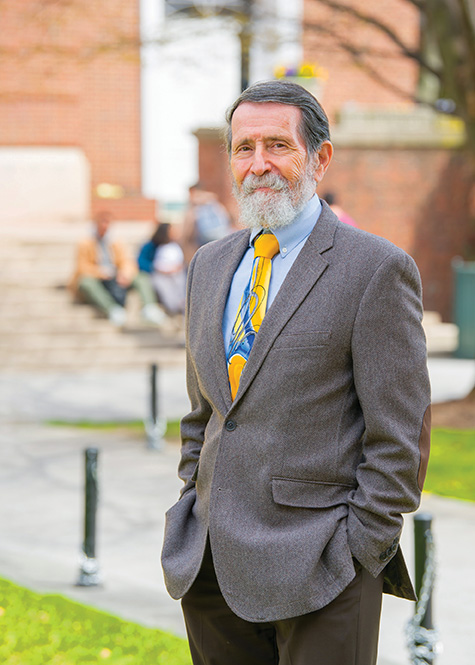 Saukin’s journey began in the South Bronx, where he was raised. Both of his parents had emigrated to America to build a new and better life, his father from Russia and his mother from Poland. “I was that new life,” Saukin reflects. “I had an obligation to do my best and prove to my parents that their work and effort wasn’t for naught.”
His father told him that he couldn’t wash cars and shine shoes as a child, implying that his son should be doing something more with his life. But Saukin struggled with reading, which hurt his self-esteem and made him feel socially disconnected. In sixth grade, however, his teacher asked him to stay after school for extra help, and his reading quickly improved. He graduated from junior high school at the top of his class, and repeated this achievement at Morris High School.
“I knew I wasn’t just competing with students,” Saukin says. “I also felt like I was competing against families — students who had resources, parental guidance and modern technology — things I never really had growing up.”
Because of this, attending college had never felt like a real possibility during his childhood. His strong grades, however, changed that perception.
Saukin enrolled in the City College of New York. He pursued engineering, allured by the challenge of the field and encouraged by his stellar grades in both math and science. In elementary school, he and his friends would assemble their own scooters using wooden crates, 2x4s and roller skates. Now it was time to apply that interest in engineering at the collegiate level. Saukin proved to be a dedicated student, completing the five-year program in four-and-one half years.
After graduating in 1966, he continued at City College for graduate school and pursued the area of engineering that, in his view, had the greatest problems and the highest demand. That area was fluids and environment, which focuses largely on pollution and contamination. He married his wife Olga, who he had met years before at a New Jersey resort, in 1969. Two years after that, in 1971, Saukin graduated from City College with a Ph.D. in engineering.
That year also marked the beginning of Saukin’s long and storied career. Drawn to the environment of higher education, he decided to pursue a teaching career in engineering. He applied to many higher education institutions, but despite his credentials, only one university responded to him: the civil engineering department in Lafayette College, located in Eastern Pennsylvania. Saukin accepted the role — and also the arduous commute that came with it. On Mondays, he would leave his wife and their home in Brooklyn at 4:00 a.m., arriving at Lafayette College by 6:00 a.m. After teaching for the day, he would stay overnight in an apartment that he was renting near Lafayette. On Tuesdays, he would teach his courses and then commute back to Brooklyn to spend the night back at home.
Saukin would repeat this cycle every day for the next six years, teaching various engineering courses such as structures, solids and lab classes. He also worked at an engineering consulting firm in Allenton, Pennsylvania, assessing engineering problems and offering solutions.
In 1972 Saukin attended one of Manhattan University’s summer programs to learn more about the recently passed Clean Water Act, a law that would require all sanitary treatment plants to have secondary wastewater treatment, monitoring associated water bodies’ quality. This experience sparked Saukin’s interest in summer programs, a passion that would profoundly impact his career. The following year, he attended a summer program on ground water modeling at Princeton University. Through this program, Saukin became involved in Princeton’s water resources program. He consulted on various projects to clean ground water contamination, an area that generated much attention after the United States passed the Resource Conservation and Recovery Act in 1976.
During his summer breaks from Lafayette, Saukin worked as a consultant at Princeton. In 1977, he left Lafayette to search for new opportunities. A friend advised him to reach out to Professor William Brown, Manhattan’s head of civil engineering. Brown wound up hiring him as an assistant professor. Saukin has been teaching civil engineering at Manhattan University ever since. He was promoted to associate professor in 1981. From 1995 to 2003, he served as chair of the Civil Engineering department, running the graduate and undergraduate programs. During that time, he ensured that the curriculum was comprehensive and met top academic and industry expectations.
Over the years, Saukin has contributed immensely to the field of engineering. During the early 1980s, he ran the National Engineering Environmental Conference on behalf of Manhattan University and the American Society of Civil Engineers. Around that same time, he also became executive secretary of the New York Water Environment Association. Serving as the executive arm of the board of directors, he generated quarterly issues of the association’s Clear Waters magazine, coordinated two annual meetings, and tracked memberships.
Although he left the position in 1988, Saukin spent the next 30 years helping orchestrate Water Environment student chapters, which he had created and written into the association’s bylaws. He set up chapters across New York colleges, including Stony Brook University, New York University, Columbia University, and many others. He also raised the money that would allow Manhattan students to join the association for free. Additionally, Saukin helped create the Fire Engineering program during the early 1980s. This provided fire protection information and held exhibits and technical sessions where industry professionals could present their developments and creations.
Saukin considers his greatest achievement to be his three children: his daughter Tamara and his two sons, Walter and Jonathan. Tamara, a gifted athlete and musician who was invited to participate in a master class at the Manhattan School of Music at the age of 10, became a doctor working in family medicine. Meanwhile, both Walter and Jonathan followed in their father’s footsteps and studied civil engineering at Manhattan before going on to attain law degrees from St. John’s University. Both now work as lawyers in the engineering field.
It was 1982, however, when Saukin created what he calls one of his most significant professional contributions. By this time, he had learned how to move through a system where education, technology, and industry were continuously evolving at a rapid rate — but Saukin never forgot his roots.
“It was time to go back to the neighborhoods to share what I had learned,” he explains. “There were so many single-parent households, immigrant families like mine, and families working so hard that just didn’t have the time or resources. At the same time, the engineering industry had an ever-increasing demand for manpower. This is how my summer program came to be.”
Saukin began a summer program geared toward female and minority high school students. It offered additional educational opportunities to women and people of color and introduced them to various branches of engineering and different degree combinations.
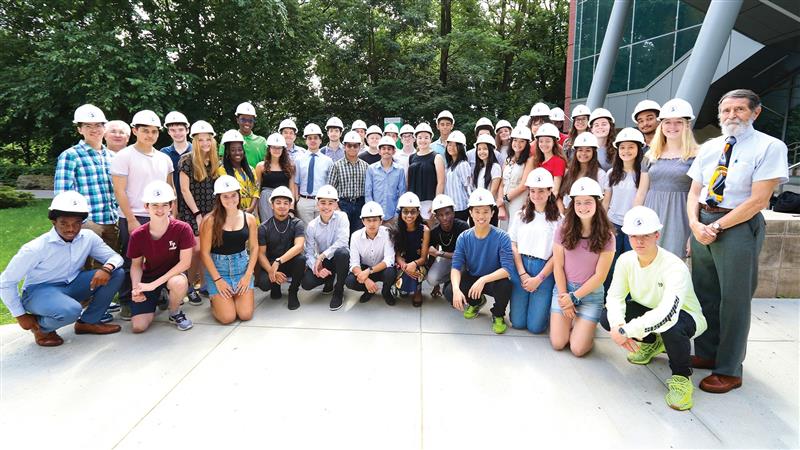
“The institution you attend will have major lifelong implications,” Saukin says. “I wanted to offer potential students a chance to explore the engineering field before committing to it.”
In his approach, Saukin saw himself in every student and felt the hopes of the parents for their children. He wanted to ensure that no one was ever overlooked. He continues to follow that approach today.
He has been running this program, now called the Summer Engineering Awareness Program, for the last 43 years. It is open to any high school student, with approximately 100 students participating every summer. Over the last 43 years, Saukin has raised money through industry grants and donations from engineering companies, corporations and nonprofits to allow students to attend his summer programs for free.
“These programs are a humanitarian service,” he says. “They show the spirit of the institution. That’s what makes Manhattan University so different.”
According to Saukin, over the past 10 years, of the 1,000 students who have participated in the program, 94% have continued on to pursue a STEM major, with 83% pursuing an engineering degree. Even more impressive, 20 to 30 participants end up enrolling at Manhattan University each year.
“As we recruit students, the industry is recruiting manpower,” Saukin notes. “I realized a need for that way back in ’82 before anyone else thought about it.”
Just a few years ago, his programs were evaluated on a national basis by Roots, a nonprofit that assesses summer programs for indigenous students and students of color. Roots ranked Manhattan’s high school program in the top 10 for U.S. high school outreach summer programs.
Over the years, Saukin has been duly honored for his contributions to the field of engineering. In 1994 the nonprofit ACE (Architecture Construction Engineering) Mentor Program of Greater New York was created to introduce engineering to high school students. Saukin was asked to join the board of directors, and in 2006, he was named the ACE Faculty Member of the Year. There have been many other honors bestowed upon him. In 2015, he was inducted into the hall of fame of the New York Water Environment Association for his contributions to the organization and its objectives. A year later, he received the New York Building Foundation Recognition Award for his summer programs and for promoting the engineering profession. In 2024, Saukin received the Chairs Award from the American Council of Engineering Companies of New York. Most recently, in the spring of 2025, Saukin received one of his greatest honors when he was named an affiliate member of the Institute of the Brothers of the Christian Schools, the highest honor bestowed by the Brothers.
Saukin remains optimistic about the future of engineering. “The skillsets associated with engineering are generally marketable,” he says. “We live in a technical society, and our skillsets now need to be technically based.” Not even the emergence of artificial intelligence has shaken Saukin’s spirits. “Historically, engineers have used AI to create computer models to solve sophisticated problems,” he explains. “So AI is really nothing new to an engineer.”
After 48 years at Manhattan University, Saukin has no plans for stopping. “As long as the flesh is functional and the spirit is strong, I plan to keep working,” he laughs. In the 2025-26 academic year, he’ll be teaching Material Labs, where students test metals, concrete, and the nature of materials. He also plans to continue helping students with his summer programs, though he is working with professors to carry on these programs in his eventual retirement. He’s also trying to set up an endowment to help support the program going forward.
“Manhattan was the first place where I felt like mind, body and spirit came together,” he reflects. “This is where I was always meant to be. You can feel like your spirit has found a home.”
As featured in the Fall 2025 issue of Manhattan Magazine.